
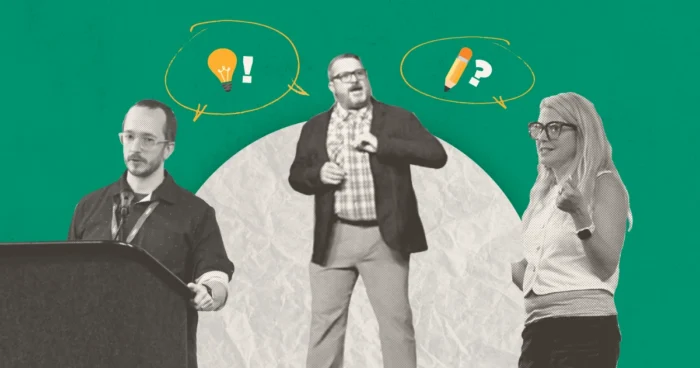
This fall, the DR team has been on the road. We’ve been part of conferences, keynotes and a lot of conversations with smart people who are wrestling with the same things our partners are.
Here’s where our heads are.
Four Types of Travelers Identified in our Proprietary Research
Marketing plans almost always default to demographic targeting: age, income, zip code. But demographics alone are not a strategy. Two people who look identical on paper can want entirely different things from the same experience or product, and one message trying to reach them both usually resonates with neither.
We partnered with Audience Audit on proprietary research to look at how people decide on where and how to travel, but in a different way. We didn’t want to slice the same demographic data, but posed a different kind of question entirely: What do these people want? What do they believe? What are they hoping the travel experience will do for them?
Out of that research, four distinct traveler types emerged. They show up across markets, across regions, across demographics. And each one of them responds to a fundamentally different kind of message.
Enthusiastic Immersives (26%) want to be changed by the travel experience they’ve chosen. They don’t want a checklist. They want depth, texture and a trip that stays with them long after it’s over. If you’re marketing to them, lead with that transformation, not the details. What will they feel? What will they understand about themselves or the world that they didn’t before they showed up?
Trendy Planners (27%) have already built the trip to your destination in their heads. They’ve scrolled the photos (both yours AND those from other visitors and influencers), read the captions and imagined the story they’ll tell when they get back. What they need from you in both your marketing and the in-market visit is confirmation: proof that the reality matches what they’ve imagined, and the language to share it. Social proof and shareable moments are the currency here.
Cautious Budgeters (24%) want to say yes to visiting your destination, but they need validation that they are making the right choice with their time and dollars. Value matters to them, and so does specificity. Vague promises of a great time won’t move them. Concrete details (what exactly am I getting, is this a safe place to visit, what will this actually cost including taxes and resort fees, what do people like me say about it) do.
Independent Explorers (23%) are travelers who plan their own route and prefer it that way. They want access and space, and they don’t want to follow an itinerary. The more you over-market to this group, the more they tune you out. Give them the lay of the land and let them find their own way.
So a takeaway here is to look at your current content, campaigns and social channels. Which of the traveler types are you speaking to? Which one(s) are you accidentally ignoring? Most organizations are unconsciously optimizing for one or two of these travelers but not speaking to the others.
You don’t have to rebuild your strategy from scratch, but it sure does help to know who you’re actually talking to.
There is a lot more detail on this research, and tips on how to implement it in this presentation with DR’s Pat Strader and Susan Baier from Audience Audit: youtu.be/BWuEu0-sGtQ
You Know AI is on this List
In this moment, 65% of adults are using AI and 77% of devices have some form of it built in. That’s the reality of where we are today.
Our Chief Creative Officer Abbey Reifsnyder has been giving a talk this fall that isn’t an argument against AI, but advocates for intentionality when using AI. What we’re experiencing right now is that many organizations aren’t necessarily being intentional with AI use. They’re just… using it. It crept in. We are no longer talking about if we should use AI, but tackling the much harder, and ever-changing question of how.
We all know that AI is very good at pattern recognition because it’s built on millions of inputs and works from real people. There are a lot of valid and helpful ways that AI makes our work more efficient. But shew, you better not build your brand using AI. Don’t market your destination using AI-generated assets or content.
The data is starting to back this up. In a survey of 2,000 travelers across the UK and Italy, 72% said AI-generated photos made them less likely to book, and 47% named AI images as the single biggest turnoff when browsing tours. A separate Clutch study from June 2026 found that 33% of consumers say AI use worsens their view of a brand, while only 16% say it improves it. Among younger audiences, it’s even more pronounced: 54% of Gen Z say heavy AI use would reduce their trust in a brand they previously liked.
Perhaps an even harder truth to reconcile is that travelers can’t reliably spot AI content. In one study, only 5% of respondents correctly identified all the real destination photos. But that doesn’t make it safe or right. When people suspect something is artificial, or find out later that it was, the damaged trust is real (see Trendy Planners and Conscious Budgeters above, especially). The Tennessee Department of Tourist Development responded to this directly with its “Yeah, It’s Real” certification. It’s a commitment that their marketing photos are unaltered, with photographer, timestamp and location attached to every image.
New Mexico followed suit in July 2026 with its “Keep it True” pledge, where the state Tourism Department announced it would reject generative AI in destination advertising, and dozens of tourism businesses and DMOs across the state signed on, committing to show only real people and real landscapes in their marketing.
An element of this that may be harder, but not impossible, for DMOs to tackle is the conversation that they’ll need to have with their members about refraining from using generative AI in their marketing assets. That commitment to authenticity really needs to be followed by every business, attraction and lodging property that supports tourism in a destination.
Accessibility Should Not Be On Your Back Burner
More than one in four of your potential customers is excluded when your digital content isn’t accessible for them.
When it comes to the tourism industry, travelers with disabilities spend close to $50 billion a year on travel in the United States alone. Eighty-one percent of those travelers use the internet to research and book their trips, an all-time high. If your website doesn’t work for them, they don’t complain; they just go somewhere else.
Those ADA Title II deadlines (April 2027 for larger organizations, April 2028 for smaller ones) apply to government entities and businesses serving the public. But if your organization receives federal funding, you may also fall under Section 508, which is already in effect. For DMOs operating on federal grants, tourism boards and nonprofits that contract with state or local agencies, the funding sources play a role in your compliance requirements. DR’s amazing digital designer, Caitlynn Jones, broke down the difference between these two frameworks and what each one requires.
This fall, our Technical Director Justin Ferrell has been sharing why this work is important, and it’s not just for legal reasons. Curb cuts, the little ramps built into every street corner, were designed for wheelchair users but now they’re essential for strollers, delivery carts and anyone hauling luggage through an airport. Closed captions were built for people who are deaf or hard of hearing, but now they run in quiet offices and loud bars and living rooms everywhere, for people who have no hearing impairment at all. If you solve a problem for the person who needs it most, you almost always make the experience better for everyone else too.
Here are the seven practical things you can do right now to make your website more accessible:
Alt text. Describe the image the way you’d describe it to someone over the phone. Not “outdoor recreation.” Instead, “A group of six rafters paddling through whitewater rapids.”
Color contrast. Turn on grayscale in your phone’s accessibility settings and pull up your own website. If text disappears into its background, that’s what your colorblind visitors are already seeing.
Keyboard navigation. Act like a new user and try to complete your site’s main action (requesting information, booking, signing up) using only your keyboard. If you get stuck, so do your users.
Video captions. YouTube auto-captions are a good first step, but not a finished product. Someone still needs to read and fix them.
Descriptive language. “Click here” and “Read more” say nothing to a screen reader. Descriptive link text also helps search engines and AI tools understand your content.
Talk to a disabled person. Your local Center for Excellence in Disabilities is a good place to start. You’ll learn more from those real conversations than by making accessibility updates based on assumptions.
Tell people what you actually have. If your venue, destination or property has an ADA accessible feature, state that clearly on your website, somewhere a person can find it before they arrive on-site.
If you’ve been pitched an accessibility overlay or widget (a little floating icon that claims to make your site compliant), that is not the answer to your access problem. It can’t make your site compliant. The practitioners who work in this every day, including the people who wrote the accessibility standards themselves, have been clear about this.
Accessibility has to be built into your site from the start; it isn’t a layer you bolt on at the end. But good faith progress, i.e., a real, documented effort to improve, matters both legally and for the people trying to navigate your site.
So, what connects everything we’ve explored this fall? The organizations that will stand out in the years ahead will be those that take the time to understand their audiences, keep their creative process authentic and prioritize accessibility in everything they build.
If you want to talk about any of this further, reach out or join the conversation.